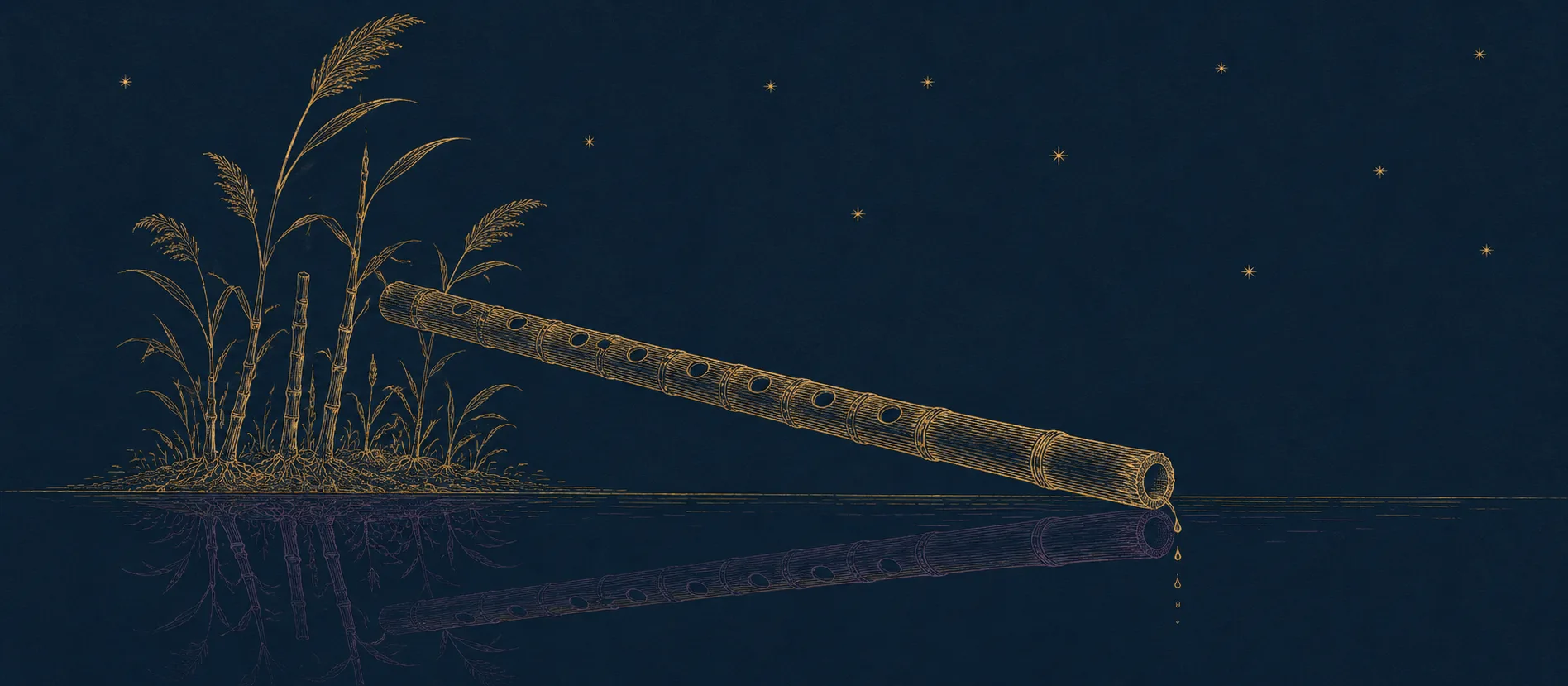
The opening of Rumi's Masnavi — the Afghan poet who wrote the world's greatest meditation on longing, exile, and what beauty is born from suffering.
“Listen to the reed, how it tells a tale,
complaining of separations.”
Bishnow az ney chon hekāyat mi-konad
Az jodāyi-hā shekāyat mi-konad
The Masnavi opens with an unbroken 18-couplet meditation on the reed before any narrative begins. These are six of the most essential — each one a further turn of the same wound.
Farsi text is public domain (13th century). Translations by the House of Afghanistan, in the tradition of Nicholson (1925) and Whinfield (1887).
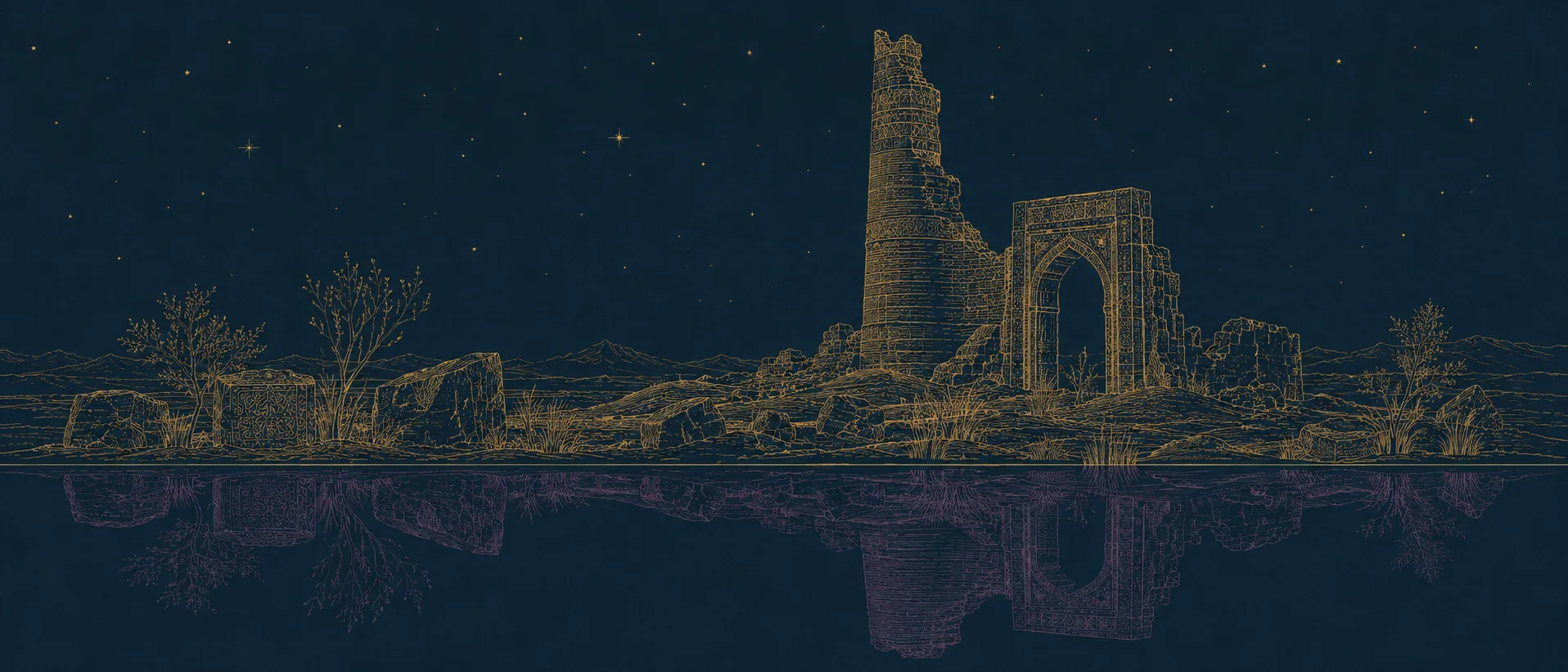
Rumi was born in Balkh, Khorasan — then a major capital and center of learning in the Islamic world. He left as a child. He would never return. But the city never left him.
Into a family of scholars and Sufi teachers in the city that is now in northern Afghanistan. His father, Bahā ud-Dīn Walad, was a preacher, teacher, and mystical-minded religious scholar. Britannica · Franklin D. Lewis, Rumi: Past and Present, East and West (Oneworld, 2000)
Rumi's family left Greater Khorasan in the 1210s and undertook a multi-stage migration through Nishapur, Baghdad, Mecca, and eventually westward to Anatolia. Scholars disagree on whether the departure was driven chiefly by political instability, patronage, or fear of the approaching Mongols — the leading specialized view holds the family likely departed before the Mongol sack of Balkh in 1220, not during it.[2] Rumi was still a child. He would never return. Lewis (2000) · Britannica
In Konya (now Turkey), Rumi encountered the wandering mystic Shams-e Tabrizi — a meeting that shattered and remade him. Shams became the embodiment of the divine beloved, and the sudden loss of him (Shams disappeared; some say he was killed) became the wound from which Rumi’s greatest poetry poured.
Rumi began dictating the Masnavi-ye Ma'navi to his disciple Ḥusām al-Dīn. Over the next decade he produced one of the longest poems in world literature — about 26,000 verses (roughly 50,000 lines), written primarily in Persian, with some Arabic.[1] An ocean of Sufi philosophy, folktales, and lyric poetry, opening from those first two lines about the reed. Encyclopaedia Iranica · Britannica
He died on December 17, 1273. His tomb in Konya became one of the great pilgrimage sites of the Islamic world. He is buried far from Balkh — but his words traveled everywhere.
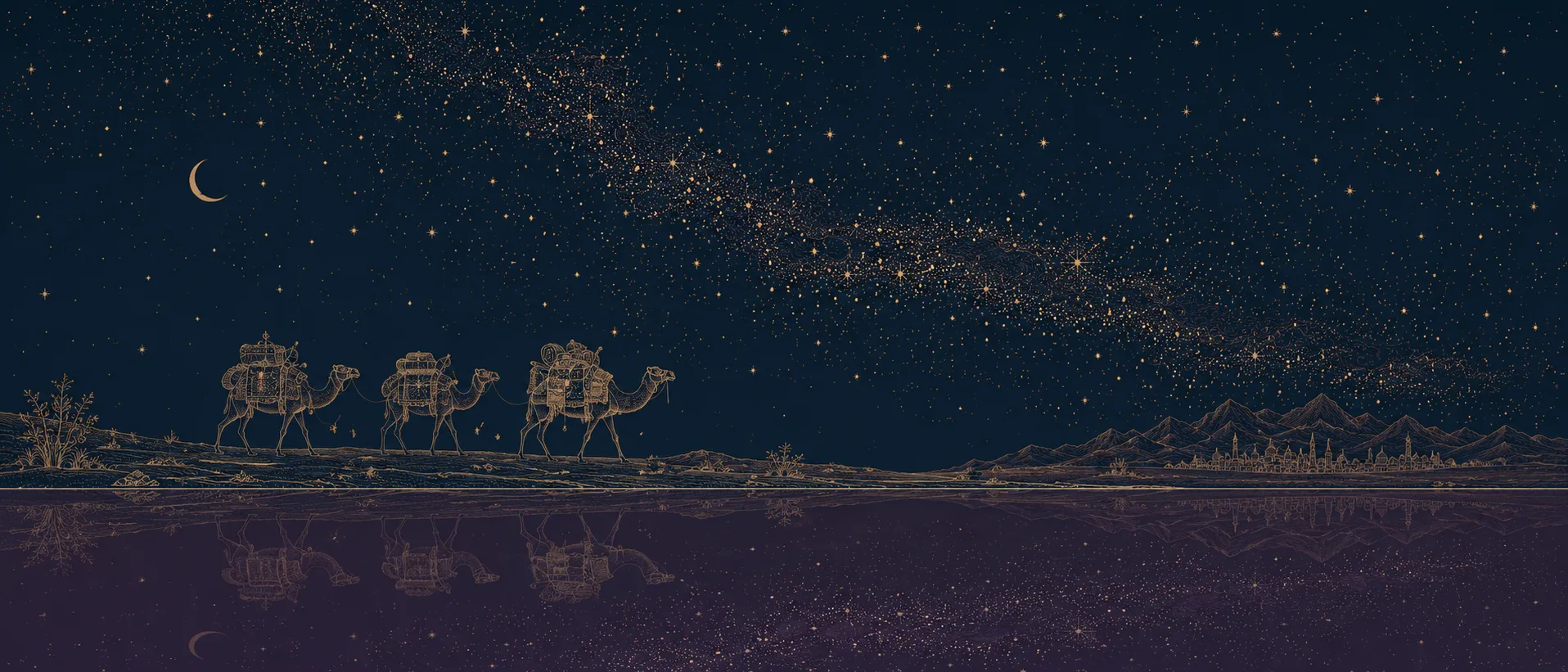
Rumi's family fled Balkh ahead of the Mongol invasions — a journey that would last decades and never reach home again. He died in Konya, far from where he was born. But his words traveled everywhere.
The Masnavi begins with a sustained metaphor: a reed flute, cut from the reed bed where it was born, cries continuously. Its music is its longing. The flute does not merely play — it weeps. And people gather to hear it, because they recognize in that weeping something they also carry.
Rumi's reed is the soul cut from its divine origin. But for any person of the diaspora — any Afghan who grew up between two worlds, who inherited the food and the language but not always the meaning — the reed is also us. We are the instrument made from what was cut away. Our music is the sound of that separation, trying to find its way back.
Every page of the House of Afghanistan closes with the couplet. It is not decoration. It is our position statement — our acknowledgment that we are an institution built by a people who know what it means to be separated from the reed bed of their inheritance.
We do not perform those lines. We mean them. The House was founded because a generation inherited fragments — beautiful, beloved fragments — without the roots that gave them meaning. To gather those roots, to pass them forward whole, is the work of the reed: to sing what was lost, so that it is not forgotten.
Afghanistan has never lacked for suffering. Its people have been cut and cut again — by invasion, by exile, by the long distances between homeland and hope. A lesser philosophy might ask: why?
Rumi's answer is older than the question. The reed does not make music despite the cut. It makes music because of it. The hollow that lets breath through was made by the very separation it mourns. The wound is not incidental to the song — the wound is the instrument.
This is not a theology of resignation. It is something harder: a philosophy of transmutation. Every Afghan who carried this language across the world did not leave their pain at the border. They carried it as the reed carries the memory of the reed bed — and from that carrying, they made something. Food. Language. Poetry. The customs a child learns before they know what they mean.
The patience — the deep, unhurried certainty that tomorrow can be better than today — is not naïveté. It is earned. It is the lesson of the ney. You endure. You wait. And in the waiting, you discover that what was taken from you has given you a voice the world had not heard before.
This philosophy is not taught in classrooms. It lives in the language itself — in the way Farsi holds longing and beauty in a single word, in the way a poem can carry an entire civilization across a century of silence. Rumi knew this, because he lived it. Exiled from Balkh, cut from his reed bed, he wrote the greatest poetry of the Persian language — from the wound.
The House of Afghanistan was founded on this understanding. Not to mourn what was lost, but to sing it. Because the song is how it is kept. And because it is the song, not the silence, that travels.
Beauty rises from suffering. Greatness rises from the ashes. Patience carries the seed of tomorrow. This is not only what Rumi wrote about — it is what the Afghan people have lived.
The language Rumi wrote in is Farsi — part of the Persian linguistic continuum spoken in this region for more than a millennium. Dari, the Afghan dialect of Persian, is Farsi-e Dari: Afghan Persian. The two are not separate languages. They are the same voice, shaped by different landscapes, carrying the same vast inheritance.
Classical Persian literature first flourished across Greater Khorasan and Transoxiana[5] — regions spanning present-day Afghanistan, Iran, Tajikistan, and Uzbekistan. Ferdowsi, who wrote the Shahnameh (the great Persian Book of Kings, revered across all Farsi-speaking peoples including Afghans), came from Tus in Khorasan. Rumi came from Balkh. Rābi'a Balkhi, one of the earliest known women poets of the Farsi tradition, came from Balkh. Sanā'i of Ghazna — from present-day Afghanistan — was a great predecessor of Persian mystical poetry and an early master of the didactic mystical masnavi. He did not invent the masnavi verse form itself, which is older; he pioneered its use for Sufi teaching.[4] Encyclopaedia Iranica, “Sanāʾī”
The Afghan contribution to Persian literature is not a footnote. It is a founding chapter. The House of Afghanistan exists, in part, to make sure the next generation of Afghans knows this — not as a point of pride alone, but as a source of genuine understanding: where the inheritance comes from, and why it matters.
To close every page with Rumi's line is to close it the way he opened his life's work: by asking the reader, first, to listen. Not to learn, not to consume — to listen. The reed teaches nothing. It only sings of what it has lost. And somehow, that is enough.
“Listen to the reed, how it tells a tale,
complaining of separations.”